 Growney
Why the Moon changes shape. A lamp and ball experiment

Yesterday the Moon was completely round, and a week later only half of it was left. Where did the rest go? Children ask this very early on, and you can literally show them the answer with your hands.
The one-sentence answer
The Moon doesn’t shine on its own
The Moon doesn’t have its own light. It shines because sunlight falls on it, and this lit-up side always faces the Sun. The Moon itself isn’t disappearing. The only thing that changes is how much of its bright side we can see from Earth.
The Moon orbits the Earth. When it gets between the Earth and the Sun, its lit side faces away from us, and the Moon is almost invisible. When the Earth is between the Moon and the Sun, we see the whole bright side, which is a full moon. A full cycle from one new moon to the next takes about 29 and a half days.
The eight phases
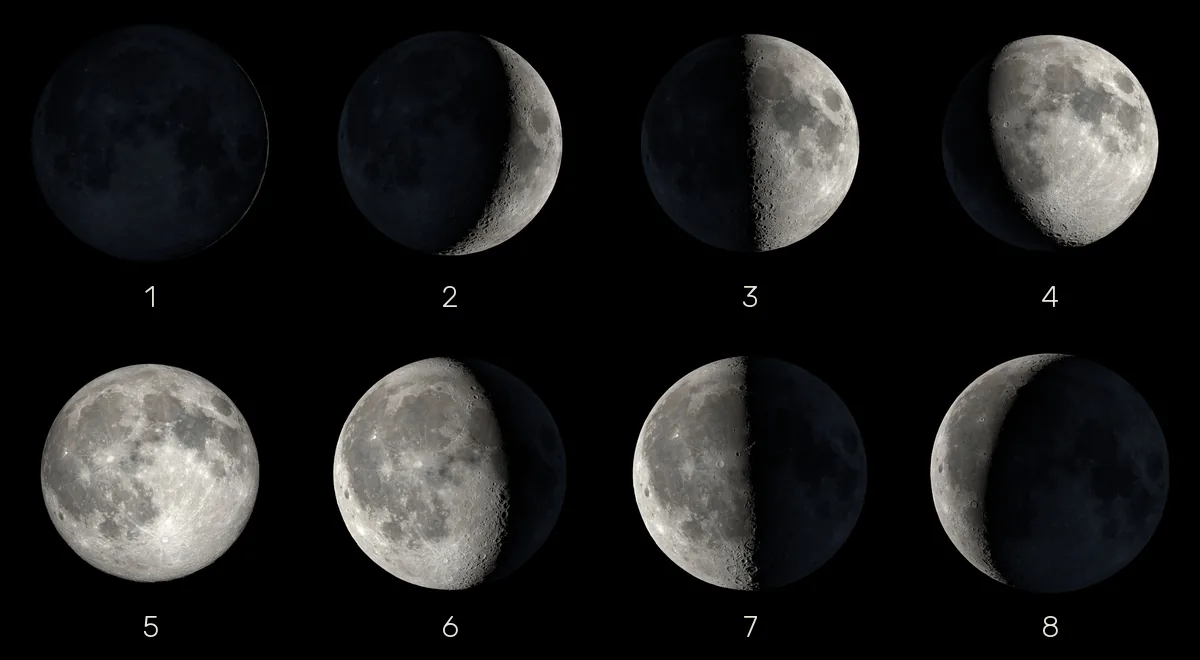
- New Moon. The Moon is between Earth and the Sun; it is almost invisible.
- Waxing Crescent. A thin sliver appears, growing thicker every day.
- First Quarter. A lit-up half-circle.
- Waxing Gibbous. The bright part is larger than a half.
- Full Moon. The whole round disk is visible.
- Waning Gibbous. The bright part starts to shrink.
- Last Quarter. Half again, but on the opposite side.
- Waning Crescent. A thin sliver before the next new moon.
How to tell if the Moon is waxing or waning
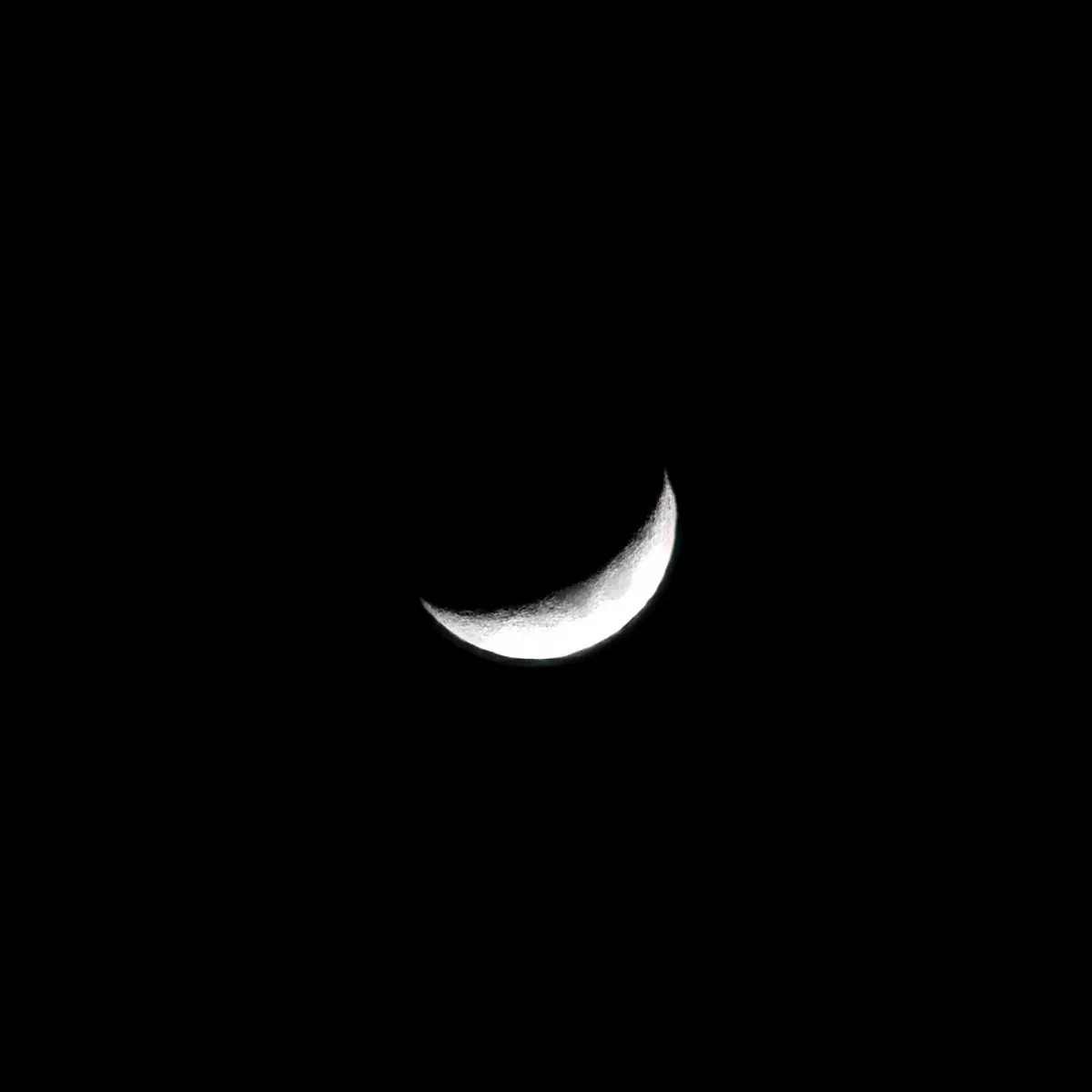
In the Northern Hemisphere, there is an easy trick. If you can draw a straight line against the crescent to make the letter “b” (or “p” in some languages), it is being born (waxing). If it looks like a “c”, it is shrinking (waning). In the Southern Hemisphere, like Australia, it’s the exact opposite because they look at the Moon upside down relative to us.

Here’s another fun fact: we always see the exact same side of the Moon. It spins on its axis in exactly the same amount of time it takes to orbit the Earth, so one half is constantly facing us.
A kitchen experiment with a lamp and a ball
NASA uses this very experiment in their lessons. The lamp will be the Sun, the ball will be the Moon, and your head will be the Earth.
- Take the shade off a desk lamp and put it on a table. Turn off all other lights in the room.
- Stick a pencil into a small, light-coloured polystyrene ball.
- Face the lamp and hold the ball at arm’s length, slightly above your head. The lit side is facing away from you. This is the New Moon.
- Slowly turn to your left on the spot, keeping your arm raised. First, a thin crescent will appear on the right side of the ball, then a half.
- When the lamp is behind your back, hold the ball higher so your head doesn’t block the light. You will see a Full Moon.
- Keep turning, and the bright part will start shrinking from the other side.
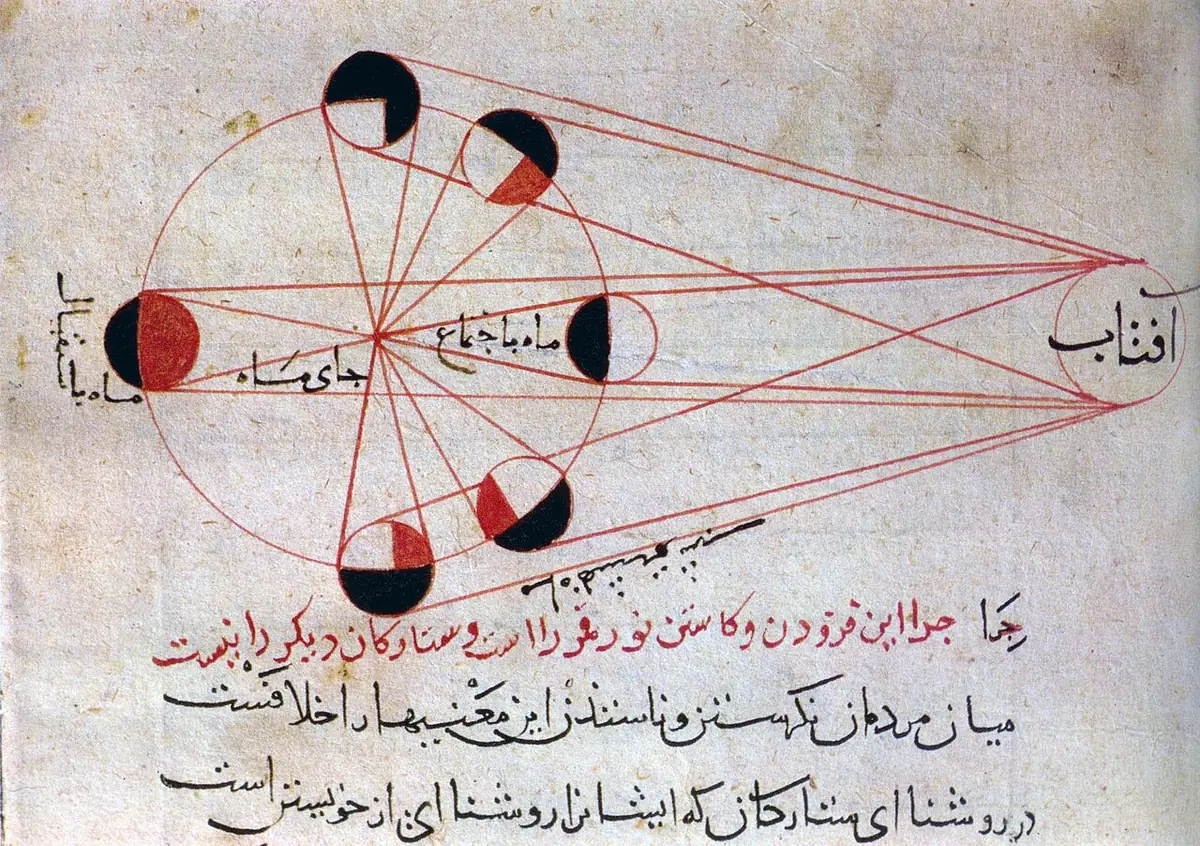
A similar diagram, showing the Sun lighting up half the Moon at every step of its journey around the Earth, was drawn by the Persian scholar al-Biruni almost a thousand years ago. A copy of his manuscript is on the cover of this article. The idea hasn’t changed since then, simply because it’s correct.