 Growney
Which dinosaurs lived in Poland and Ukraine. Telling your child

Sooner or later, a child who has met Tyrannosaurus in a book asks whether dinosaurs lived near us too. Mongolia and America are impressive, but a find close to home feels even more exciting. Poland and Ukraine have some remarkable stories to tell.
The answer in one sentence
The oldest footprints in the Holy Cross Mountains
At Stryczowice in Poland's Holy Cross Mountains, tiny footprints survive in the rock. They are about 250 million years old. The largest print is only 4 centimetres long. They were left by a small animal walking on four legs, from the branch that later gave rise to dinosaurs. The palaeontologists Stephen Brusatte and Grzegorz Niedźwiedzki called them the oldest known evidence of the dinosaur lineage. The animal walked there shortly after the greatest mass extinction in Earth's history.
Fifty million years later, a wide river flowed through the same hills, near Sołtyków. Meat-eating dinosaurs, long-necked plant-eaters, and early ornithischians walked along its banks. The largest predator footprint there is 54 centimetres long. Scientists describe it as the largest meat-eating dinosaur footprint from the Early Jurassic of Poland.
Silesaurus from near Opole
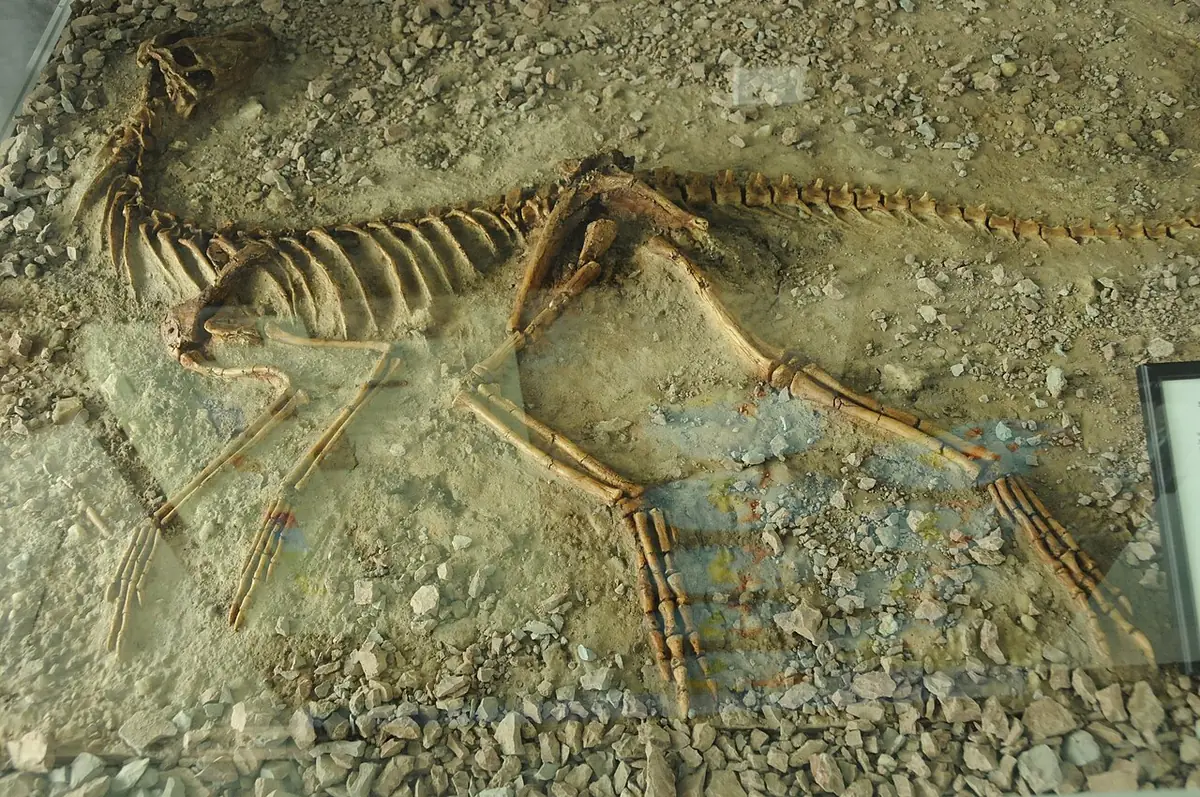
In the village of Krasiejów near Opole, there is an old clay pit. In 2003, the palaeontologist Jerzy Dzik described a new animal from it and named it Silesaurus, which means the lizard from Silesia. Silesaurus lived about 230 million years ago. The front of its lower jaw ended in a beak. Scientists estimate that it weighed around 15 kilograms, roughly as much as a medium-sized dog. They still argue about whether it was a true dinosaur or a very close relative.
In 2010, an educational park was built right over the dig site at Krasiejów.

Smok from Lisowice
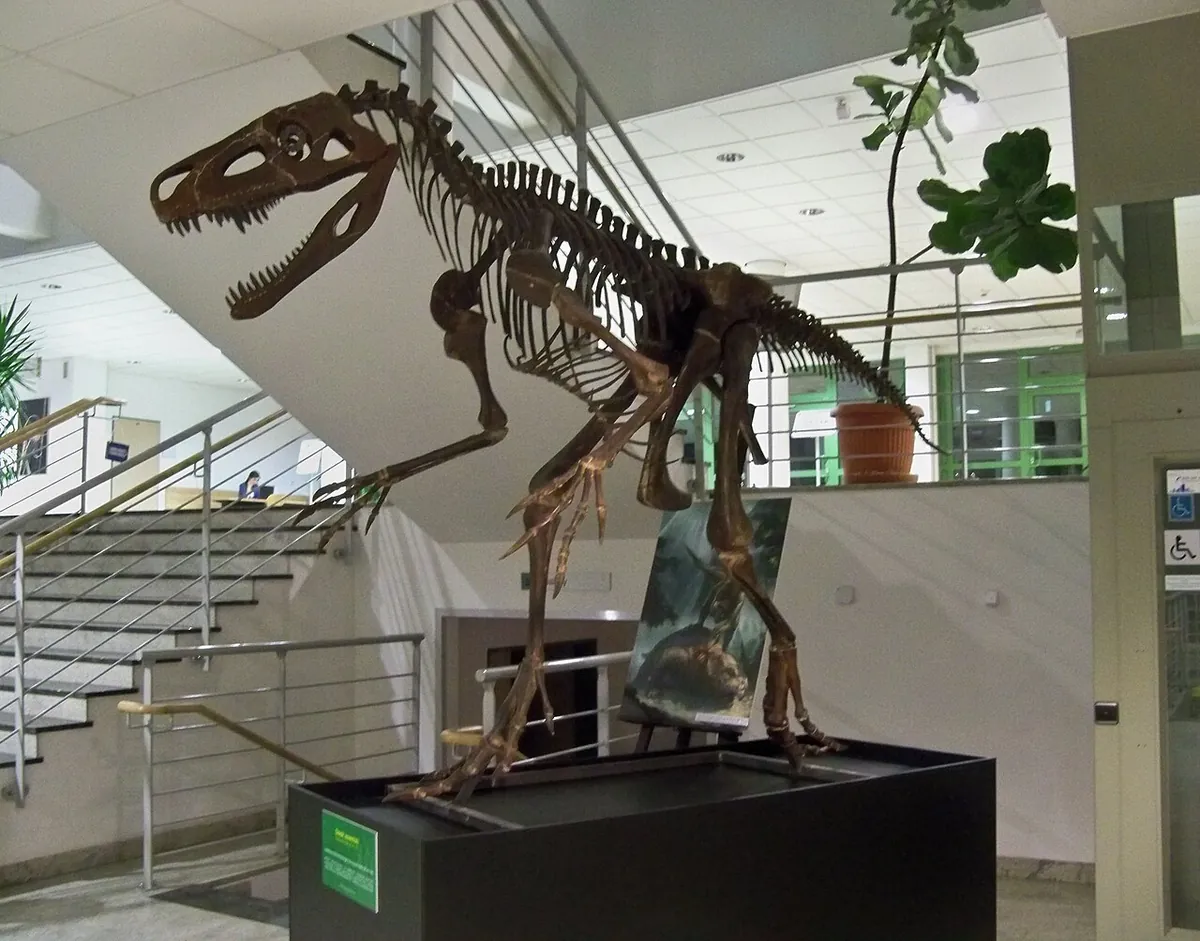
Another clay pit, at Lisowice in Silesia, produced a predator. It is between 205 and 200 million years old. Its skeleton was 5 to 6 metres long, and its skull 50 to 60 centimetres. Scientists know of no bigger predator from that time in Central Europe. They named it Smok wawelski, after the dragon in a legend from Kraków.
Researchers have not yet decided whether Smok was a dinosaur. Some of its bones look like those of meat-eating dinosaurs, and others like those of large crocodile relatives. We do know what it ate, though. In 2019, scientists studied its fossil droppings. Up to half of their volume was bone. Smok crushed bones like a modern hyena.
The same clay pit also gave up Lisowicia, a giant relative of mammals. It was the size of an elephant, about 4.5 metres long and 2.6 metres tall, and weighed around 9 tonnes.
What was found in Ukraine
During the age of dinosaurs, part of what is now Ukraine lay under the sea. Near Nova Ushytsia, in the Khmelnytskyi region, there was a shallow, warm sea between 98 and 95 million years ago, with water at 17 to 20 degrees. Its sediments hold sharks, fish, marine reptiles, and shells. Dinosaurs lived on land, so their bones turn up only rarely in rocks laid down in the sea.
Crimea, though, has a real dinosaur. Fragments of its thigh bone and ankle bones were found on Besh-Kosh mountain. It lived at the end of the Cretaceous and was a plant-eating relative of Iguanodon. In 2020, the palaeontologists Lopatin and Averianov named it Riabininohadros. A second Crimean dinosaur is known from neck and back vertebrae. So at least two kinds of dinosaur lived in Crimea at that time.
A footprint game at home
- Measure up. Draw a footprint 4 centimetres long on paper, like the ones at Stryczowice, and another 54 centimetres long, like the one at Sołtyków. Ask your child to put a foot next to each. Which one is bigger than their foot?
- Tracks in dough. Roll out salt dough or modelling clay. One person secretly makes tracks with a toy, and the other guesses who walked past and on how many legs.
- What did Smok eat? Hide a few beads inside a ball of modelling clay. They are the "beetles and bones". Your child slices it with a plastic knife, like scientists who look through fossil droppings layer by layer.
- Map. On a map of Poland and Ukraine, mark Opole, Lisowice, the Holy Cross Mountains, Nova Ushytsia, and Crimea. Next to each, write who lived there.
One more amazing fact
In 2021, scientists from Uppsala University looked inside a fossil dropping from Krasiejów that is thought to come from Silesaurus. They scanned it with a synchrotron, a kind of extremely powerful X-ray, and found whole tiny beetles inside. They were a new species, Triamyxa coprolithica. It is the first insect ever described from fossil droppings.
Silesaurus is waiting in Growney Dino too. There, your child digs across a map of the world and, in Poland, uncovers Silesaurus and Lisowicia. Under Ukraine, they find a note suggesting they look for dinosaurs next door.